How to Win Your Bracket Pool (2026 Edition)

Before you begin reading this article, I want to make one thing abundantly clear: I’m not telling you how to fill out the perfect bracket; that’s impossible (insert cliché about the astronomically small odds of this ever happening). Rather, I’m giving you statistically sound, pragmatic advice on how to win your bracket pool between you and your friends (and the spoils that come along with it). If you follow these foolproof steps, you should finish at (or at the very least near) the top:

Step 1: Advance all 1 and 2 seeds to the Sweet 16.

Okay, I know, this is super chalky and people may rag on you for making this move. Furthermore, the odds are heavily against all eight 1 and 2 seeds advancing to the Sweet 16. However, picking which 1 or 2 seed is going to get upset is a fool’s gambit. You put yourself at risk of losing easy points that your opponents will gain. You’re better off taking a couple small gambles in other early round games, and just playing it safe here.

To further drive home my point, consider this – in the last three tournaments, 19 of the 24 teams (79%) on the 1 and 2 seed line advanced to the Sweet 16. If you can essentially lock in 6 correct teams in your predicted Sweet 16, you should do it.

Step 2: Advance all 3 & 4 seeds to the second round.

The same chalkiness mentioned in step 1 definitely applies here as well, but the same logic applies as well. The difference here is that a lower seed upset over a 3 or 4 in the second round is much more likely in comparison to a similar 1 or 2 upset. Thus, auto-advancing the 3 & 4 seeds should only apply to the first round. It’s fun bragging about being the one person who accurately picked the crazy upset, but you know what’s more fun? Bragging about winning your bracket pool.

In a similar fashion to step 1, I really want to drive home this point as well. In the last four tournaments, only one 14 over 3 upset has occurred, and it was a 4-point victory by Oakland over Kentucky in 2024. Similarly, 13 seeds are 2-14 against 4 seeds in that same timeframe. In the modern NIL era, big upsets are going to be fewer and further in between.

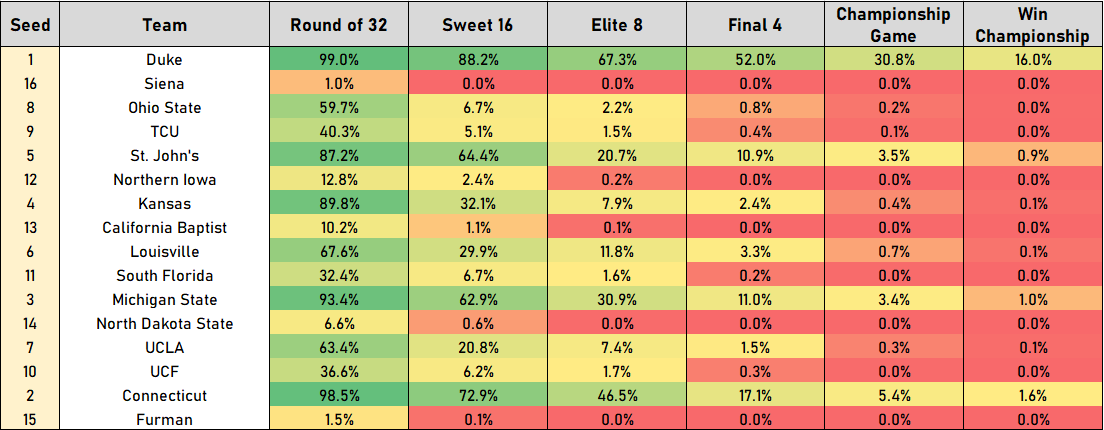
Step 3: Use the following statistical data to fill out the rest of your bracket.
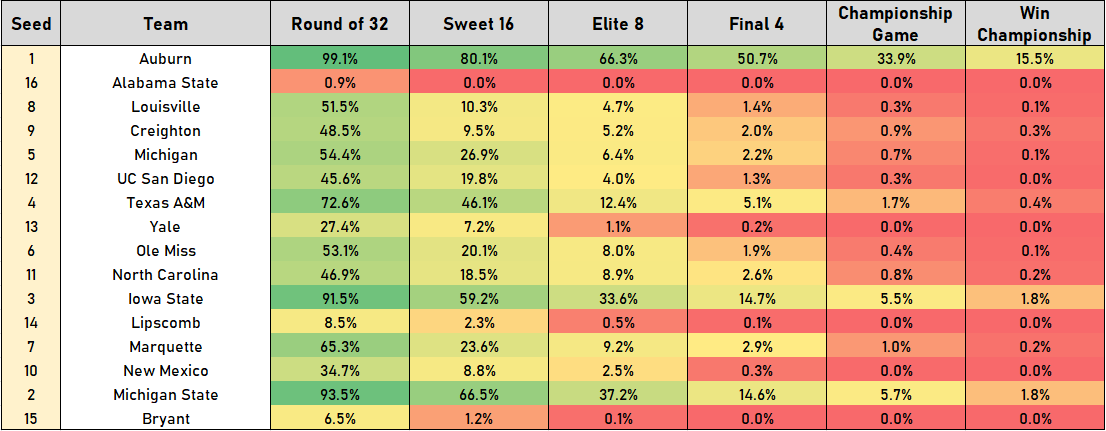
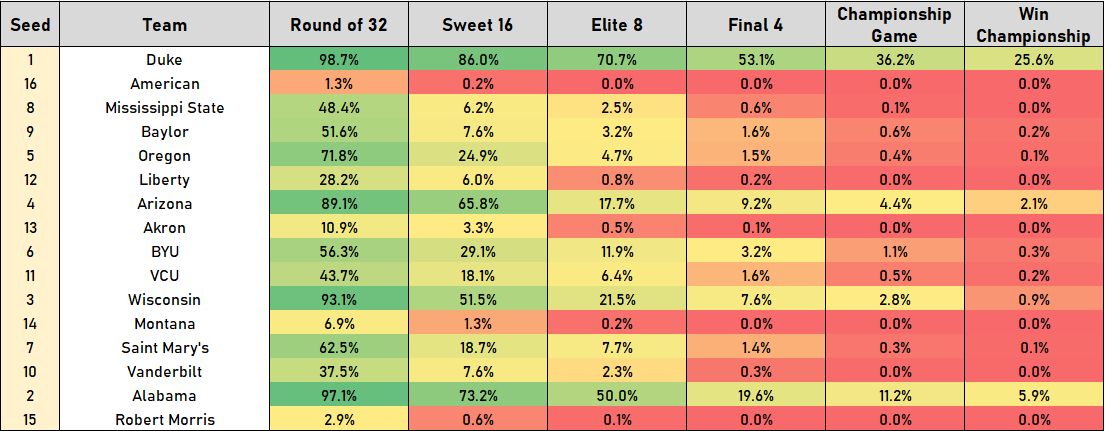
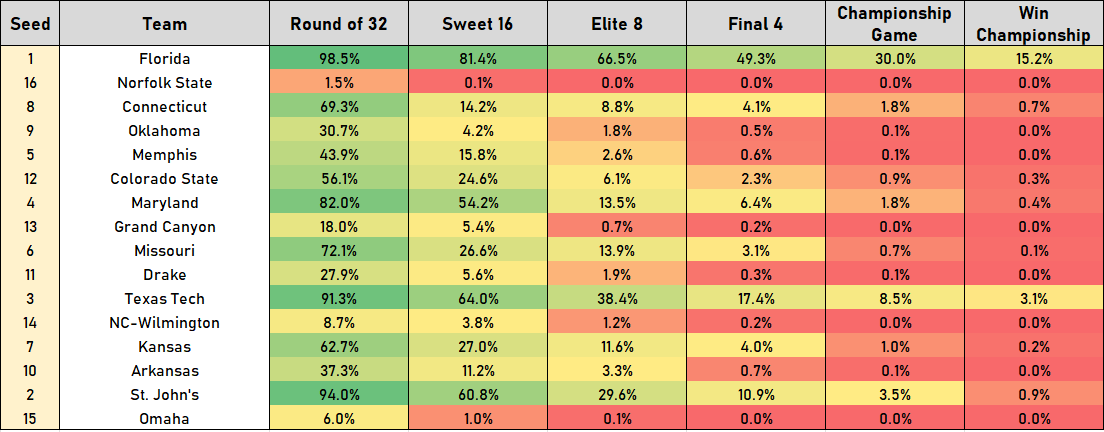
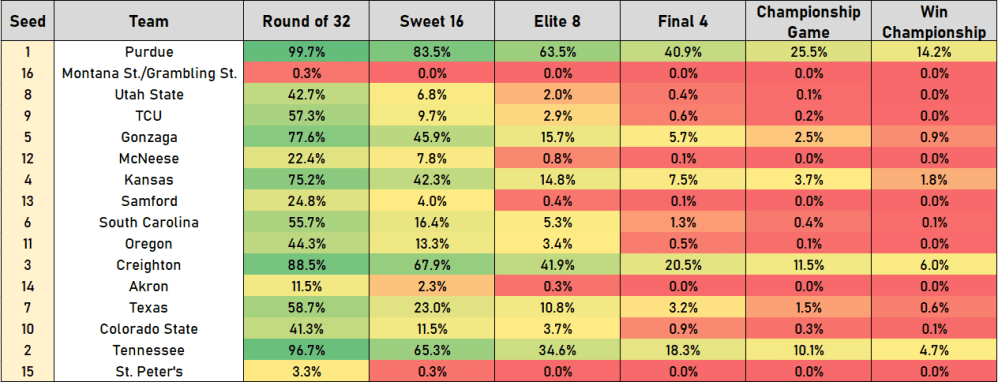
(*Note*: The 0% values listed do not imply that the result cannot happen. Rather, the result is extremely unlikely [less than 0.1% likelihood])

In years past, I had developed a predictive model to attempt to project who has the best chance of advancing far into the tournament. I refined the model to further optimize the predictive results, then normalized the projections for each region to create a probability of advancing in any given round for every team in the tournament. I used historic tournament results from games that took place between 2010 to 2017.

As part of an update from 2019, I moved to a model that predicts the exact score of each game. After the projected score is developed, the model turns that into a projected probability of victory, then uses rules of conditional probability to project teams advancing in the tournament. I also updated the training data for the model to include tournament results from games that took place between 2016 and 2025.

East Region
West Region
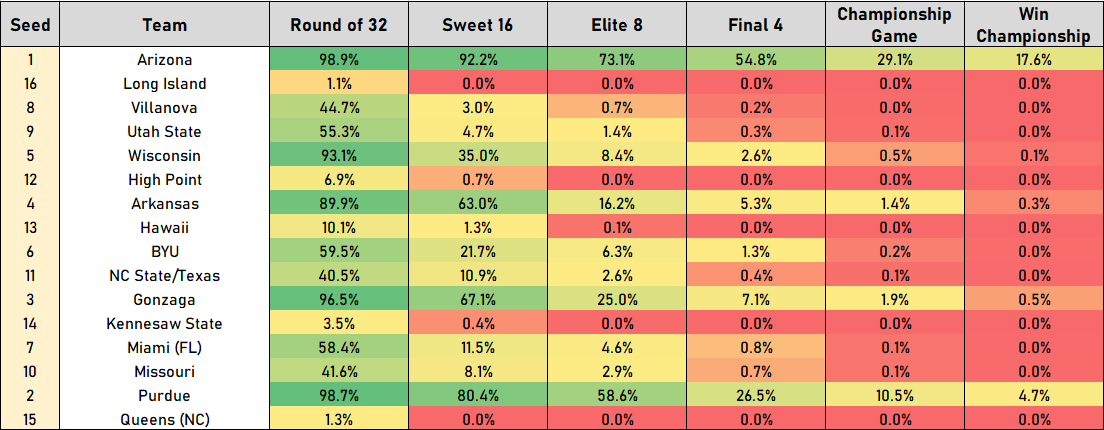
Midwest Region
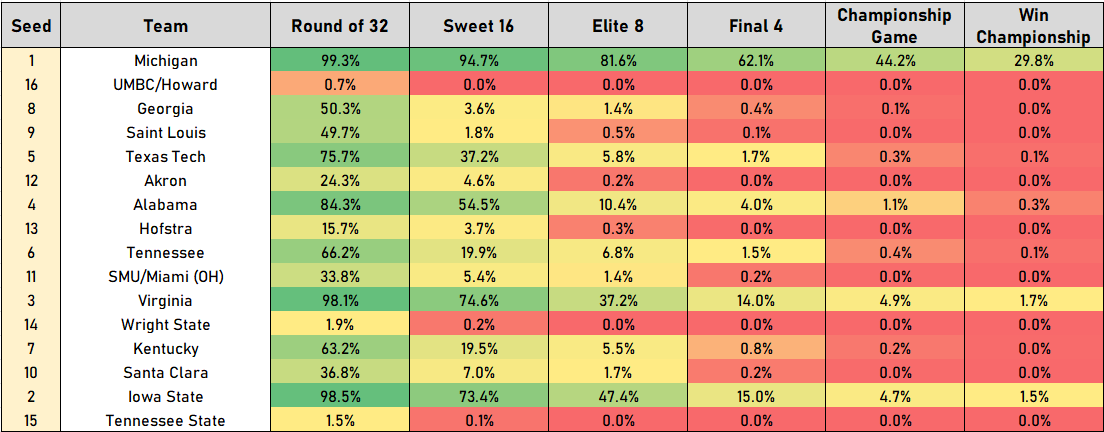
South Region
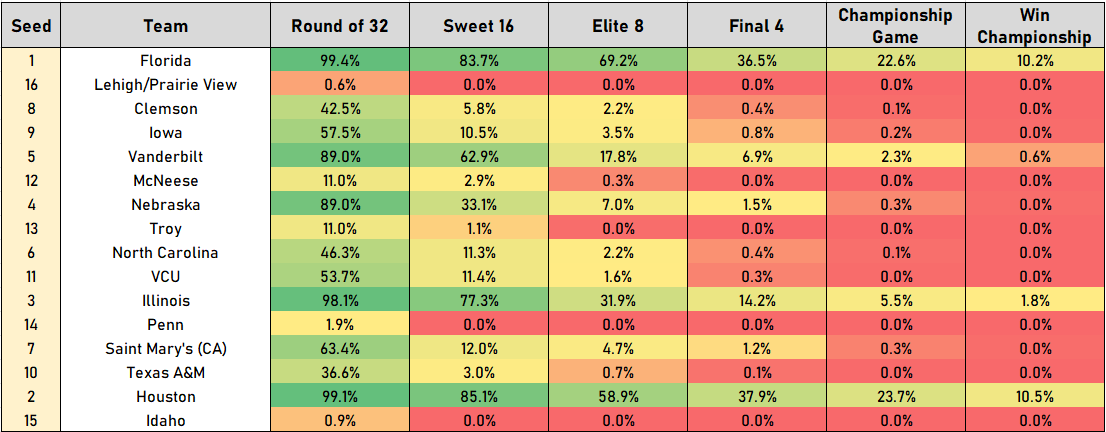
Bonus TL;DR version: Synthesizing the above charts for people who don’t like numbers.

Most Likely First Round Upsets

Going crazy picking a ton of upsets doesn’t do you any good. Instead, I would pick one (or two tops if you’re feeling real wild) from the following options:

Most Likely 12/5 Upset

  • (12) Akron over (5) Texas Tech – 24.3%

Most Likely 11/6 Upsets

  • (11) VCU over (6) North Carolina – 53.7%
  • (11) NC State/Texas over (6) BYU – 40.5%

Toss-Up Games

These are the 7/10 and 8/9 games that could get either way. The goal here is to get 5+ out of 8 correct. I recommend the following strategy:

  • (8) Ohio State vs. (9) TCU – Take Ohio State.
  • (7) UCLA vs. (10) UCF – Take UCLA.
  • (8) Villanova vs. (9) Utah State – Take Utah State.
  • (7) Miami (FL) vs. (10) Missouri – Take Miami (FL).
  • (8) Georgia vs. (9) Saint Louis – Flip a coin.
  • (7) Kentucky vs. (10) Santa Clara – Take Kentucky.
  • (8) Clemson vs. (9) Iowa – Take Iowa.
  • (7) Saint Mary’s vs. (10) Texas A&M – Take Saint Mary’s.

Best Final Four Picks by Region

EAST

Chalk – (1) Duke

Value Pick – (2) UConn, (3) Michigan State

Dark Horse – (5) St. John’s


WEST

Chalk – (1) Arizona

Value Picks – (2) Purdue

Dark Horse – N/A (no good value)


MIDWEST

Chalk – (1) Michigan

Value Pick – (2) Iowa State, (3) Virginia

Dark Horse – N/A (no good value)


SOUTH

Chalk – (2) Houston, (1) Florida

Value Pick – (3) Illinois

Dark Horse – (5) Vanderbilt


Most Likely Champions

  • (1) Michigan (29.8%)
  • (1) Arizona (17.6%)
  • (1) Duke (16.0%)
  • (2) Houston (10.5%)
  • (1) Florida (10.2%)
  • (2) Purdue (4.7%)

High Leverage Futures Bets (Men’s Edition – 2026)

I took the baseline model I developed for my “How to Win Your Bracket Pool” article and created a “high-volatility” version to produce bracket simulations so I could look for teams that are uniquely capable of making unexpected runs in this year’s tournament. I compared the results of these simulations to currently available Vegas futures on three sports betting websites (DraftKings, FanDuel, and MGM) to look for high leverage opportunities in the high risk/high reward space.

I identified seven such opportunities (in order of shortest to longest odds):

  • Arkansas advancing to the Sweet 16 (-120 on DraftKings)
  • Michigan advancing to the Final 4 (-115 on MGM)
  • Vanderbilt advancing to the Sweet 16 (-110 on DraftKings)
  • St. John’s advancing to the Sweet 16 (-105 on DraftKings)
  • Houston advancing to the Elite 8 (+110 on DraftKings)
  • Virginia advancing to the Elite 8 (+325 on MGM)
  • Purdue advancing to the Final 4 (+410 on FanDuel)

High Leverage Futures Bets (Women’s Edition – 2026)

I took my baseline NCAA Women’s Basketball Tournament projection model and created a “high-volatility” version to produce bracket simulations so I could look for teams that are uniquely capable of making runs in this year’s tournament. I compared the results of these simulations to currently available futures on DraftKings and FanDuel to look for high leverage opportunities.

I identified four such opportunities (in order of shortest to longest odds):

  • Vanderbilt advancing to the Elite 8 (-120 on DraftKings)
  • Maryland advancing to the Sweet 16 (+115 on DraftKings)
  • TCU advancing to the Elite 8 (+120 on FanDuel)
  • Texas winning the National Championship (+850 on FanDuel)

High Leverage Futures Bets (Men’s Edition – 2025)

I took the baseline model I developed for my “How to Win Your Bracket Pool” article and created a “high-volatility” version to produce bracket simulations so I could look for teams that are uniquely capable of making unexpected runs in this year’s tournament. I compared the results of these simulations to currently available Vegas futures on the two primary sports betting websites (DraftKings & FanDuel) to look for high leverage opportunities in the high risk/high reward space.

I identified seven such opportunities (in alphabetical order):

  • Alabama advancing to the Elite 8 (+120 on DraftKings)
  • Colorado State advancing to the Sweet 16 (+400 on DraftKings)
  • Iowa State advancing to the Elite 8 (+220 on DraftKings)
  • Kansas advancing to the Sweet 16 (+240 on FanDuel)
  • Tennessee advancing to the Elite 8 (+120 on FanDuel)
  • Texas Tech advancing to the Elite 8 (+180 on FanDuel)
  • VCU advancing to the Sweet 16 (+370 on FanDuel)

How to Win Your Bracket Pool (2025 Edition)

Before you begin reading this article, I want to make one thing abundantly clear: I’m not telling you how to fill out the perfect bracket; that’s impossible (insert cliché about the astronomically small odds of this ever happening). Rather, I’m giving you statistically sound, pragmatic advice on how to win your bracket pool between you and your friends (and the spoils that come along with it). If you follow these foolproof steps, you should finish at (or at the very least near) the top:

Step 1: Advance all 1 and 2 seeds to the Sweet 16.

Okay, I know, this is super chalky and people may rag on you for making this move. Furthermore, the odds are heavily against all eight 1 and 2 seeds advancing to the Sweet 16. However, picking which 1 or 2 seed is going to get upset is a fool’s gambit. You put yourself at risk of losing easy points that your opponents will gain. You’re better off taking a couple small gambles in other early round games, and just playing it safe here.

To further drive home my point, consider this – in the last five tournaments, 30 of the 40 teams (75%) on the 1 and 2 seed line advanced to the Sweet 16. If you can essentially lock in 6 correct teams in your predicted Sweet 16, you should do it.

Step 2: Advance all 3 seeds to the second round.

The same chalkiness mentioned in step 1 definitely applies here as well, but the same logic applies as well. The difference here is that a lower seed upset over a 3 in the second round is much more likely in comparison to a similar 1 or 2 upset. Thus, auto-advancing the 3 seeds should only apply to the first round. It’s fun bragging about being the one person who accurately picked the crazy 14 over 3 upset, but you know what’s more fun? Bragging about winning your bracket pool.

In a similar fashion to step 1, I really want to drive home this point as well. In the last three tournaments, only one 14 over 3 upset has occurred, and it was a 4-point victory by Oakland over Kentucky in 2024.

Step 3: Use the following statistical data to fill out the rest of your bracket.
(*Note*: The 0% values listed do not imply that the result cannot happen. Rather, the result is extremely unlikely [less than 0.1% likelihood])

In years past, I had developed a predictive model to attempt to project who has the best chance of advancing far into the tournament. I refined the model to further optimize the predictive results, then normalized the projections for each region to create a probability of advancing in any given round for every team in the tournament. I used historic tournament results from games that took place between 2010 to 2017.

As part of an update from 2019, I moved to a model that predicts the exact score of each game. After the projected score is developed, the model turns that into a projected probability of victory, then uses rules of conditional probability to project teams advancing in the tournament. I also updated the training data for the model to include tournament results from games that took place between 2014 and 2023.

South Region

East Region

Midwest Region

West Region

Bonus TL;DR version: Synthesizing the above charts for people who don’t like numbers.

Most Likely First Round Upsets

Going crazy picking a ton of upsets doesn’t do you any good. Instead, I would pick one (or two tops if you’re feeling real wild) from the following options:

Most Likely 13/4 Upsets

  • (13) Yale over (4) Texas A&M – 27.4%
  • (13) High Point over (4) Purdue- 25.0%

Most Likely 12/5 Upsets

  • (12) Colorado State over (5) Memphis – 56.1%
  • (12) UC San Diego over (5) Michigan – 45.6%

Most Likely 11/6 Upsets

  • (11) North Carolina over (6) Ole Miss – 46.9%
  • (11) VCU over (6) BYU – 43.7%

Toss-Up Games

These are the 7/10 and 8/9 games that could get either way. The goal here is to get 5+ out of 8 correct. I recommend the following strategy:

  • (8) Louisville vs. (9) Creighton – Flip a coin.
  • (7) Marquette vs. (10) New Mexico – Take Marquette.
  • (8) Mississippi State vs. (9) Baylor – Flip a coin.
  • (7) Saint Mary’s vs. (10) Vanderbilt – Take Saint Mary’s.
  • (8) Gonzaga vs. (9) Georgia – Take Gonzaga.
  • (7) UCLA vs. (10) Utah State – Take UCLA.
  • (8) Connecticut vs. (9) Oklahoma – Take Connecticut.
  • (7) Kansas vs. (10) Arkansas – Take Kansas.

Best Final Four Picks by Region

SOUTH

Chalk – (1) Auburn

Value Pick – (3) Iowa State, (2) Michigan State

Dark Horse – N/A (No good value)


EAST

Chalk – (1) Duke

Value Picks – (2) Alabama, (3) Wisconsin

Dark Horse – (4) Arizona


MIDWEST

Chalk – (1) Houston

Value Pick – (2) Tennessee

Dark Horse – (8) Gonzaga, (6) Illinois


WEST

Chalk – (1) Florida

Value Pick – (3) Texas Tech

Dark Horse – (4) Maryland


Most Likely Champions

  • (1) Duke (25.6%)
  • (1) Auburn (15.5%)
  • (1) Florida (15.2%)
  • (1) Houston (15.1%)
  • (2) Alabama (5.9%)
  • (2) Tennessee (5.4%)

High Leverage Futures Bets (Women’s Edition – 2025)

I took my baseline NCAA Women’s Basketball Tournament projection model and created a “high-volatility” version to produce bracket simulations so I could look for teams that are uniquely capable of making unexpected runs in this year’s tournament. I compared the results of these simulations to currently available futures on DraftKings (unfortunately, FanDuel limits Women’s futures to Final 4 and Champion) to look for high leverage opportunities with plus odds.

I identified four such opportunities (in order of shortest to longest odds):

  • Maryland advancing to the Sweet 16 (+120)
  • Ohio State advancing to the Sweet 16 (+125)
  • Duke advancing to the Elite 8 (+130)
  • LSU advancing to the Elite 8 (+400)

High Leverage Futures Bets (2024 Edition)

I took the baseline model I developed for my “How to Win Your Bracket Pool” article and created a “high-volatility” version to produce bracket simulations so I could look for teams that are uniquely capable of making unexpected runs in this year’s tournament. I compared the results of these simulations to currently available Vegas futures on the two primary sports betting websites (DraftKings & FanDuel) to look for high leverage opportunities in the high risk/high reward space.

I identified five such opportunities (in alphabetical order):

  • Colorado advancing to the Sweet 16 (+330 on FanDuel)
  • Creighton advancing to the Elite 8 (+205 on both sites)
  • Duke advancing to the Elite 8 (+400 on DraftKings)
  • Illinois advancing to the Elite 8 (+270 on DraftKings)
  • Washington State advancing to the Sweet 16 (+550 on DraftKings)

How to Win Your Bracket Pool (2024 Edition)

Before you begin reading this article, I want to make one thing abundantly clear: I’m not telling you how to fill out the perfect bracket; that’s impossible (insert cliché about the astronomically small odds of this ever happening). Rather, I’m giving you statistically sound, pragmatic advice on how to win your bracket pool between you and your friends (and the spoils that come along with it). If you follow these foolproof steps, you should finish at (or at the very least near) the top:

Step 1: Advance all 1 and 2 seeds to the Sweet 16.

Okay, I know, this is super chalky and people may rag on you for making this move. Furthermore, the odds are heavily against all eight 1 and 2 seeds advancing to the Sweet 16. However, picking which 1 or 2 seed is going to get upset is a fool’s gambit. You put yourself at risk of losing easy points that your opponents will gain. You’re better off taking a couple small gambles in other early round games, and just playing it safe here.

To further drive home my point, consider this – in the last five tournaments, 27 of the 40 teams (68%) on the 1 and 2 seed line advanced to the Sweet 16. If you can essentially lock in 5 or 6 correct teams in your predicted Sweet 16, you should do it.

Step 2: Advance all 3 seeds to the second round.

The same chalkiness mentioned in step 1 definitely applies here as well, but the same logic applies as well. The difference here is that a lower seed upset over a 3 in the second round is much more likely in comparison to a similar 1 or 2 upset. Thus, auto-advancing the 3 seeds should only apply to the first round. It’s fun bragging about being the one person who accurately picked the crazy 14 over 3 upset, but you know what’s more fun? Bragging about winning your bracket pool.

In a similar fashion to step 1, I really want to drive home this point as well. Since 2017, only one 14 over 3 upset has occurred, and it was a 1-point victory by Abilene Christian over Texas in 2021.

Step 3: Use the following statistical data to fill out the rest of your bracket.
(*Note*: The 0% values listed do not imply that the result cannot happen. Rather, the result is extremely unlikely [less than 0.1% likelihood])

In years past, I had developed a predictive model to attempt to project who has the best chance of advancing far into the tournament. I refined the model to further optimize the predictive results, then normalized the projections for each region to create a probability of advancing in any given round for every team in the tournament. I used historic tournament results from games that took place between 2010 to 2017.

As part of an update from 2019, I moved to a model that predicts the exact score of each game. After the projected score is developed, the model turns that into a projected probability of victory, then uses rules of conditional probability to project teams advancing in the tournament. I also updated the training data for the model to include tournament results from games that took place between 2014 and 2023.

East Region

East Region 2024

South Region

South Region 2024

Midwest Region

Midwest Region 2024

West Region

West Region 2024

Bonus TL;DR version: Synthesizing the above charts for people who don’t like numbers.

Most Likely First Round Upsets

Going crazy picking a ton of upsets doesn’t do you any good. Instead, I would pick one (or two tops if you’re feeling real wild) from the following options:

Most Likely 13/4 Upsets

  • (13) Samford over (4) Kansas – 24.8%
  • (13) Charleston over (4) Alabama – 19.3%

Most Likely 12/5 Upsets

  • (12) Grand Canyon over (5) Saint Mary’s – 31.2%
  • (12) James Madison over (5) Wisconsin – 31.0%

Most Likely 11/6 Upsets

  • (11) New Mexico over (6) Clemson – 50.4%
  • (11) Oregon over (6) South Carolina – 44.3%

Toss-Up Games

These are the 7/10 and 8/9 games that could get either way. The goal here is to get 5+ out of 8 correct. I recommend the following strategy:

  • (8) Florida Atlantic vs. (9) Northwestern – Take Florida Atlantic.
  • (7) Washington State vs. (10) Drake – Flip a coin.
  • (8) Nebraska vs. (9) Texas A&M – Flip a coin.
  • (7) Florida vs. (10) Boise St./Colorado – Flip a coin.
  • (8) TCU vs. (9) Utah State – Take TCU.
  • (7) Texas vs. (10) Colorado State – Take Texas.
  • (8) Mississippi State vs. (9) Michigan State – Take Michigan State.
  • (7) Dayton vs. (10) Nevada – Flip a coin.

Best Final Four Picks by Region

EAST

Chalk – (1) Connecticut

Value Picks – (4) Auburn, (3) Illinois

Dark Horse – (7) Washington State


SOUTH

Chalk – (1) Houston

Value Picks – (3) Kentucky, (4) Duke

Dark Horse – (6) Texas Tech


MIDWEST

Chalk – (1) Purdue

Value Pick – (3) Creighton

Dark Horse – (5) Gonzaga


WEST

Chalk – (2) Arizona

Value Pick – (3) Baylor, (4) Alabama

Dark Horse – (7) Dayton


Most Likely Champions

  • (1) Connecticut (26.3%)
  • (1) Purdue (14.2%)
  • (1) Houston (11.5%)
  • (2) Arizona (6.1%)
  • (3) Creighton (6.0%)

How to Win Your Bracket Pool (2023 Edition)

Before you begin reading this article, I want to make one thing abundantly clear: I’m not telling you how to fill out the perfect bracket; that’s impossible (insert cliché about the astronomically small odds of this ever happening). Rather, I’m giving you statistically sound, pragmatic advice on how to win your bracket pool between you and your friends (and the spoils that come along with it). If you follow these foolproof steps, you should finish at (or at the very least near) the top:

Step 1: Advance all 1 and 2 seeds to the Sweet 16.

Okay, I know, this is super chalky and people may rag on you for making this move. Furthermore, the odds are heavily against all eight 1 and 2 seeds advancing to the Sweet 16. However, picking which 1 or 2 seed is going to get upset is a fool’s gambit. You put yourself at risk of losing easy points that your opponents will gain. You’re better off taking a couple small gambles in other early round games, and just playing it safe here.

To further drive home my point, consider this – in the last five tournaments, 27 of the 40 teams (68%) on the 1 and 2 seed line advanced to the Sweet 16. If you can essentially lock in 5 or 6 correct teams in your predicted Sweet 16, you should do it.

Step 2: Advance all 3 seeds to the second round.

The same chalkiness mentioned in step 1 definitely applies here as well, but the same logic applies as well. The difference here is that a lower seed upset over a 3 in the second round is much more likely in comparison to a similar 1 or 2 upset. Thus, auto-advancing the 3 seeds should only apply to the first round. It’s fun bragging about being the one person who accurately picked the crazy 14 over 3 upset, but you know what’s more fun? Bragging about winning your bracket pool.

In a similar fashion to step 1, I really want to drive home this point as well. In the last five tournaments, 19 of the 20 teams (95%) on the 3 seed line advanced to the second round, with the lone loss being by a single point.

Step 3: Use the following statistical data to fill out the rest of your bracket.
(*Note*: The 0% values listed do not imply that the result cannot happen. Rather, the result is extremely unlikely [less than 0.5% likelihood])

In years past, I had developed a predictive model to attempt to project who has the best chance of advancing far into the tournament. I refined the model to further optimize the predictive results, then normalized the projections for each region to create a probability of advancing in any given round for every team in the tournament. I used historic tournament results from games that took place between 2010 to 2017.

As part of an update from 2019, I moved to a model that predicts the exact score of each game. After the projected score is developed, the model turns that into a projected probability of victory, then uses rules of conditional probability to project teams advancing in the tournament. I also updated the training data for the model to include tournament results from games that took place between 2014 and 2022.

South Region

South Region 2023

Midwest Region

Midwest Region 2023

West Region

West Region 2023

East Region

East Region 2023

Bonus TL;DR version: Synthesizing the above charts for people who don’t like numbers.

Most Likely First Round Upsets

Going crazy picking a ton of upsets doesn’t do you any good. Instead, I would pick one (or two tops if you’re feeling real wild) from the following options:

  • (11) Providence over (6) Kentucky
  • (13) Kent State over (4) Indiana
  • (12) VCU over (5) Saint Mary’s
  • (12) Drake over (5) Miami (FL)

Toss-Up Games

These are the 7/10 and 8/9 games that could get either way. The goal here is to get 5+ out of 8 correct. I recommend the following strategy:

  • (8) Maryland vs. (9) West Virginia – Take Maryland.
  • (7) Missouri vs. (10) Utah State – Flip a coin.
  • (8) Iowa vs. (9) Auburn – Flip a coin.
  • (7) Texas A&M vs. (10) Penn State – Flip a coin.
  • (8) Arkansas vs. (9) Illinois – Take Arkansas.
  • (7) Northwestern vs. (10) Boise State – Take Northwestern.
  • (8) Memphis vs. (9) Florida Atlantic – Flip a coin.
  • (7) Michigan State vs. (10) USC – Take Michigan State.

Best Final Four Picks by Region

  • South: (1) Alabama
  • Midwest: (1) Houston, (2) Texas
  • West: (3) Gonzaga, (1) Kansas, (2) UCLA
  • East: (1) Purdue, (4) Tennessee, (5) Duke, (2) Marquette

Best Champion Picks

  • (1) Houston
  • (1) Alabama
  • (3) Gonzaga
  • (2) Texas
  • (1) Kansas

How to Win Your Bracket Pool (2022 Edition)

Before you begin reading this article, I want to make one thing abundantly clear: I’m not telling you how to fill out the perfect bracket; that’s impossible (insert cliché about the astronomically small odds of this ever happening). Rather, I’m giving you statistically sound, pragmatic advice on how to win your bracket pool between you and your friends (and the spoils that come along with it). If you follow these foolproof steps, you should finish at (or at the very least near) the top:

Step 1: Advance all 1 and 2 seeds to the Sweet 16.

Okay, I know, this is super chalky and people may rag on you for making this move. Furthermore, the odds are heavily against all eight 1 and 2 seeds advancing to the Sweet 16. However, picking which 1 or 2 seed is going to get upset is a fool’s gambit. You put yourself at risk of losing easy points that your opponents will gain. You’re better off taking a couple gambles in other early round games, and just playing it close to the vest here.

To further drive home my point, consider this – in the last five tournaments, 28 of the 40 teams (70%) on the 1 and 2 seed line advanced to the Sweet 16. If you can essentially lock in 5 or 6 correct teams in your predicted Sweet 16, you should do it.

Step 2: Advance all 3 seeds to the second round.

The same chalkiness mentioned in step 1 definitely applies here as well, but the same logic applies as well. The difference here is that a lower seed upset over a 3 in the second round is much more likely in comparison to a similar 1 or 2 upset. Thus, auto-advancing the 3 seeds should only apply to the first round. It’s fun bragging about being the one person who accurately picked the crazy 14 over 3 upset, but you know what’s more fun? Bragging about winning your bracket pool.

In a similar fashion to step 1, I really want to drive home this point as well. In the last five tournaments, 18 of the 20 teams (90%) on the 3 seed line advanced to the second round.

Step 3: Use the following statistical data to fill out the rest of your bracket.
(*Note*: The 0% values listed do not imply that the result cannot happen. Rather, the result is extremely unlikely [less than 0.5% likelihood])

In years past, I had developed a predictive model to attempt to project who has the best chance of advancing far into the tournament. I refined the model to further optimize the predictive results, then normalized the projections for each region to create a probability of advancing in any given round for every team in the tournament. I used historic tournament results from games that took place between 2010 to 2017.

As part of an update from 2019, I moved to a model that predicts the exact score of each game. After the projected score is developed, the model turns that into a projected probability of victory, then uses rules of conditional probability to project teams advancing in the tournament. I also updated the training data for the model to include tournament results from games that took place between 2014 and 2021.

West Region

2022WestRegion

South Region

2022SouthRegion

Midwest Region

2022MidwestRegion

East Region

2022EastRegion

Bonus TL;DR version: Synthesizing the above charts for people who don’t like numbers.

Most Likely First Round Upsets

Going crazy picking a ton of upsets doesn’t do you any good. Instead, I would pick one (or two tops if you’re feeling real wild) from the following options:

  • (11) Michigan over (6) Colorado State
  • (11) Virginia Tech over (6) Texas
  • (13) South Dakota State over Providence
  • (11) ND/Rutgers over Alabama

Toss-Up Games

These are the 7/10 and 8/9 games that could get either way. I recommend the following strategy:

  • (8) Boise State vs. (9) Memphis – Take Memphis.
  • (7) Michigan State vs. (10) Davidson – Flip a coin.
  • (8) Seton Hall vs. (9) TCU – Flip a coin.
  • (7) Ohio State vs. (10) Loyola-Chicago – Flip a coin.
  • (8) San Diego State vs. (9) Creighton – Take San Diego State.
  • (7) USC vs. (10) Miami (FL) – Take Miami (FL).
  • (8) North Carolina vs. (9) Marquette – Take North Carolina.
  • (7) Murray State vs. (10) San Francisco – Flip a coin.

Best Final Four Picks by Region

  • West: (1) Gonzaga, (2) Duke
  • South: (2) Villanova, (1) Arizona, (3) Tennessee, (5) Houston
  • Midwest: (1) Kansas, (2) Auburn, (5) Iowa
  • East: (2) Kentucky, (4) UCLA, (1) Baylor

Best Champion Picks

  • (1) Gonzaga
  • (1) Kansas
  • (2) Villanova
  • (2) Kentucky
  • (4) UCLA